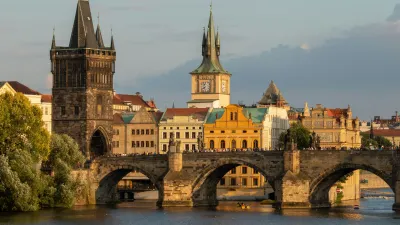
Prague
Prague, the capital of the Czech Republic, sits on the Vltava River and is one of Europe's most picturesque cities. In the 14th century, under Emperor Charles IV, it became the heart of the Holy Roman Empire and a centre of art, culture and politics. That era brought Central Europe's first university, the foundation stone of St. Vitus Cathedral at Prague Castle, the Charles Bridge and the New Town. For centuries the city was a melting pot of Czech, German and Jewish culture, and around 1900 it was home to writers and artists such as Franz Kafka, Max Brod, Rainer Maria Rilke and Franz Werfel. Its skyline mixes Romanesque, Gothic, Renaissance, Baroque and Art Nouveau buildings, plus Cubism, which found its way into architecture only here. Prague has long drawn travellers with its heritage and the romantic lanes of the Old Town, but after the Velvet Revolution of 1989 it became one of the most visited and talked-about cities in Europe, partly because it was cheaper than the traditional, overrated destinations and mostly because of its charm. That charm survived World War II and the communist era, and the modernization of the 1950s and 60s harmed it less than it did many other European cities. Many buildings were in poor shape by the late 1980s, but the historic centre was added to the UNESCO World Heritage list in 1992 and has since been almost perfectly restored. There is no single gay epicentre in Prague, but the Vinohrady district is becoming the hedonistic, stylish quarter of the city, and you will find most of the gay bars and clubs there. The queer calendar has several annual highlights: the Prague Rainbow Spring sports tournament in May, Prague Gay Pride and Prague Bear Summer in August, and the queer film festival Mezipatra in November.